
Why Content Architecture Plays a Decisive Role in AI Visibility
When AI systems like ChatGPT, Perplexity and Claude choose which sources to cite, it is not only about individual articles. The overall structure of your website and how content connects to each other plays a significant role. A well-organised content architecture signals topical authority and helps AI models understand what your website is genuinely expert in.
Traditional SEO has long advocated structured content for similar reasons, but for Generative Engine Optimization (GEO) the connections are even clearer. Large language models train on and crawl websites where they attempt to identify credible, coherent knowledge sources. A website whose content is scattered, difficult to navigate or lacks clear topical connections is less likely to be perceived as an authoritative source.
Silo Structure: Building Topical Knowledge Islands
A silo structure means organising your website's content into clearly defined topic clusters, where each silo covers a specific area in depth. The idea is that all content within a silo should be closely related to each other and link between themselves, while connections to other silos are managed more deliberately.
What Makes Up a Silo?
A silo typically consists of three levels:
- Pillar page: A broad, authoritative page that covers an overarching topic. This page acts as the hub of the silo and provides a comprehensive overview.
- Cluster content: In-depth articles and guides that address specific sub-aspects of the pillar topic. Each cluster article links back to the pillar page.
- Supporting content: Complementary resources such as case studies, glossaries, checklists and tool guides that further strengthen the silo's authority.
A Practical Example of a Silo Structure
Imagine your website focuses on GEO and AI optimisation. One silo might look like this:
- Pillar page: "Complete Guide to Generative Engine Optimization"
- Cluster articles: Technical factors for AI visibility, how to write AI-friendly content, structured data for GEO, internal linking for AI, and more.
- Supporting content: GEO glossary, GEO checklist, case studies and tool overviews.
The result is that AI models crawling or indexing your website encounter a coherent knowledge universe around a specific topic, rather than a fragmented selection of loosely related articles.
Internal Linking: Signalling Context and Authority
Internal linking is one of the most underestimated factors in GEO work. It is not just about navigation menus or breadcrumbs — it is about creating a clear semantic network of relationships between your pages.
Principles for GEO-Optimised Internal Linking
- Link contextually: Place internal links within body text where they naturally add value, rather than in isolated "related articles" blocks at the bottom of the page.
- Use descriptive anchor texts: The anchor text should clearly describe what the linked page is about. Avoid generic phrases such as "click here" or "read more".
- Link hierarchically: Cluster articles should always link back to their pillar page. The pillar page should link out to relevant cluster articles. This two-way linking strengthens the cohesion of the entire silo.
- Avoid link fragmentation: A page with too few internal links is perceived as isolated. Aim for each page to have at least three to five relevant internal links.
- Prioritise deep linking: Link directly to the most relevant page, not to a category overview or homepage, unless that is genuinely the most relevant destination.
How AI Models Interpret Internal Linking
Large language models and AI crawlers analyse link structures to understand which pages are most important and how content connects. A page with many incoming internal links from related content signals that it is central and credible within its subject area. This is similar to how traditional search engines use PageRank, but with a stronger focus on semantic relevance rather than link volume alone.
Semantic Clustering: Helping AI Understand Your Topic Universe
Semantic clustering is about organising content based on topical relevance and conceptual relationships, not just URL structure or categories. It is one of the most powerful strategies for building topical authority with AI models.
What Is Semantic Density?
Semantic density refers to how thoroughly a topic is covered within a given content cluster. A website with high semantic density around a topic has addressed it from many different angles — definitions, technical aspects, practical applications, case studies and comparisons. AI models tend to perceive such websites as more authoritative sources compared to websites that have only one or a few pages on the subject.
Strategies for Semantic Clustering
- Cover the full topic spectrum: Identify all relevant questions, concepts and sub-topics within your area and ensure your website provides answers to them.
- Use consistent terminology: If you use specific terms and concepts, use them consistently throughout the website. Inconsistent terminology makes it harder for AI to build an accurate picture of your expertise.
- Create conceptual bridges: Write content that explicitly connects related concepts and explains how they relate to each other. Such content helps AI understand the relationships within your knowledge domain.
- Update and supplement existing content: Semantic coverage is not only about creating new content. Updating and deepening existing articles with related concepts and questions also strengthens semantic density.
URL Structure and Navigation Architecture
Your URL structure should reflect your silo structure. A hierarchical URL structure clearly communicates to both search engines and AI crawlers how content is organised.
Recommended URL Structure for Silos
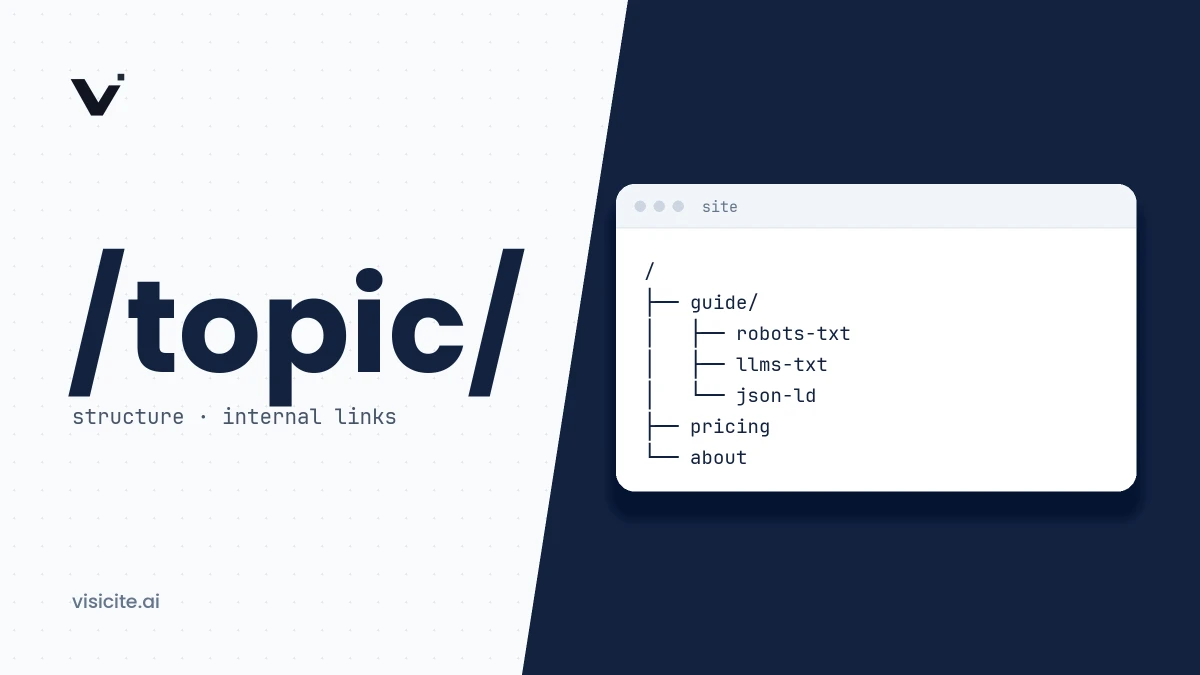
A clear hierarchy might look like this:
/geo-optimisation/— Pillar page for the GEO silo/geo-optimisation/internal-linking/— Cluster article/geo-optimisation/structured-data/— Cluster article/geo-optimisation/silo-structure/— Cluster article
This structure makes it immediately clear that the cluster articles belong to the GEO silo. It also makes it easier for AI crawlers to quickly map the content structure without needing to analyse the full text of every page.
The Navigation Menu as an Architecture Tool
Your main navigation should reflect your primary silos. Avoid filling the navigation with too many categories — instead, select the three to five most important subject areas and let them serve as clear hubs in your information architecture. An overcrowded navigation signals a lack of focus, which can weaken your perceived topical authority.
Common Structural Mistakes to Avoid
Several common structural problems can significantly reduce your AI visibility:
- Cannibalising content: Multiple pages covering exactly the same topic without clear differentiation creates confusion for AI about which page is the authoritative source.
- Orphaned pages: Pages without incoming internal links are difficult for AI crawlers to find and are perceived as peripheral, regardless of how good the content is.
- Flat structure without hierarchy: A website where all pages sit at the same level lacks the hierarchical signalling that helps AI understand what is most important.
- Inconsistent categorisation: Mixing topics between silos without clear logic weakens topical cohesion and makes it harder for AI to identify your core expertise.
How to Audit Your Current Content Architecture
Before you begin restructuring, it is important to understand where you currently stand. A GEO audit of your content architecture should include:
- Inventory of existing content: List all pages and categorise them by topic. Identify natural clusters and any content gaps.
- Internal link structure analysis: Map how pages link to each other. Identify orphaned pages and pages with unusually few incoming links.
- Semantic coverage analysis: Evaluate how well each topic cluster covers its subject area. Which questions are left unanswered? Which concepts are missing?
- URL and navigation review: Verify that your URL structure and navigation reflect your desired silo structure.
GEO auditing tools can automate large parts of this analysis and provide concrete recommendations about where structural improvements will have the greatest impact on your AI visibility.
Summary: Architecture as the Foundation for AI Authority
A well-structured content architecture is not a one-time effort — it is ongoing work that requires regular review as your website grows and the expectations of AI models evolve. The three pillars — silo structure, internal linking and semantic clustering — work together to create a website that AI models can understand, trust and want to cite.
Remember that AI models are fundamentally trying to find the most credible and relevant sources for every question they answer. A website with clear, coherent and in-depth coverage of its subject area has significantly better conditions for becoming that source.