
Why E-Commerce Needs a Dedicated GEO Strategy
When consumers ask AI tools like ChatGPT, Perplexity, or Google AI Overviews which product they should buy, a new type of purchase decision is taking place. The answer the AI provides is not a list of ads – it is an editorial recommendation based on the sources the model judges to be most credible and informative. For e-commerce businesses, this represents a fundamental shift in how visibility is created.
Traditional SEO for e-commerce is about ranking for product searches. GEO for e-commerce is about being referenced when AI assembles an answer to questions like "What is the best running shoe for overpronation?" or "What should I consider when buying an espresso machine?" That is a different playing field with different rules.
The good news is that e-commerce websites often already have the raw materials needed – product specifications, customer reviews, and category descriptions. The challenge is structuring and presenting these in a way that AI models can interpret, evaluate, and want to cite.
Product Descriptions That AI Wants to Reference
Most product descriptions on e-commerce websites are written to convert, not to inform. They emphasize emotion and brand rather than factual information. AI models, by contrast, prioritize content that provides concrete, verifiable answers to specific questions.
Write Fact-Driven, Comparable Descriptions
A product description optimized for AI citability should contain clear, factual statements that answer the questions a buyer actually asks. Think in terms of:
- What the product does: Describe the function concretely, not metaphorically. "Filters 99.97% of particles down to 0.3 micrometers" is more citable than "gives you clean air to breathe."
- Who the product is for: Specify the target audience and use case. "Suitable for runners with overpronation and a neutral arch" gives the AI a clear answer to reference.
- What distinguishes the product from alternatives: Comparative information – without negatively naming competitors – helps the AI place the product in context.
- Technical specifications in plain language: Complement structured data with a readable summary of the most important specifications directly in the text.
Answer the Buyer's Actual Questions
Analyze what questions your customers actually ask – via customer service, product reviews, and search data – and answer them directly in the product description. A section with the heading "Is this product right for you?" followed by concrete criteria is exactly the format AI models tend to cite when helping a user determine whether a product fits their needs.
Structure the product description in clear sections with their own subheadings. AI models handle well-structured content better than continuous prose without hierarchy.
Avoid Generic Superlatives
Phrases like "the best on the market" or "unbeatable quality" are not only ineffective for GEO – they can actively harm your credibility in AI models' assessments. AI models are generally trained to discount advertising language and prioritize neutral, factual content. Replace superlatives with specific claims that can be verified or substantiated.
Customer Reviews as a GEO Asset
Customer reviews are one of the most underutilized GEO resources for e-commerce. Well-written, detailed reviews contain exactly what AI models look for: authentic, specific experiences from real users in real situations.
Encourage Detailed Reviews
Generic five-star reviews that say "Great product, fast delivery" are worthless from a GEO perspective. Instead, encourage your customers to write reviews that describe:
- Their specific use case and situation
- How the product performed against their expectations
- Concrete pros and cons they have experienced
- Comparisons with products they have previously used
You can facilitate this with smart forms that request specific information, or with follow-up emails that guide the customer toward a more detailed response.
Surface and Structure Review Content
Ensure that review content is accessible to AI crawlers – not hidden behind JavaScript rendering or pagination that requires interaction. Aggregated ratings and a selection of the most informative reviews should be visible in the initial HTML.
Consider creating editorially compiled "review summaries" based on customer feedback. A section that summarizes what hundreds of customers have highlighted as the product's strengths and weaknesses is a format AI models generally value highly.
Implement Review Schema Correctly
Structured data for reviews signals to AI models that your content is verifiable and well-organized. Implement Review and AggregateRating schema according to specification with correct values for ratingValue, reviewCount, and bestRating. This is covered in more detail in the structured data section below.
Structured Data: The Foundation for AI-Readable Product Information
Structured data is the most direct way to communicate product information to AI models in a format they can interpret without ambiguity. For e-commerce, correctly implemented structured data is not optional – it is a fundamental prerequisite for competitive GEO visibility.
Product Schema: More Than Just the Basics
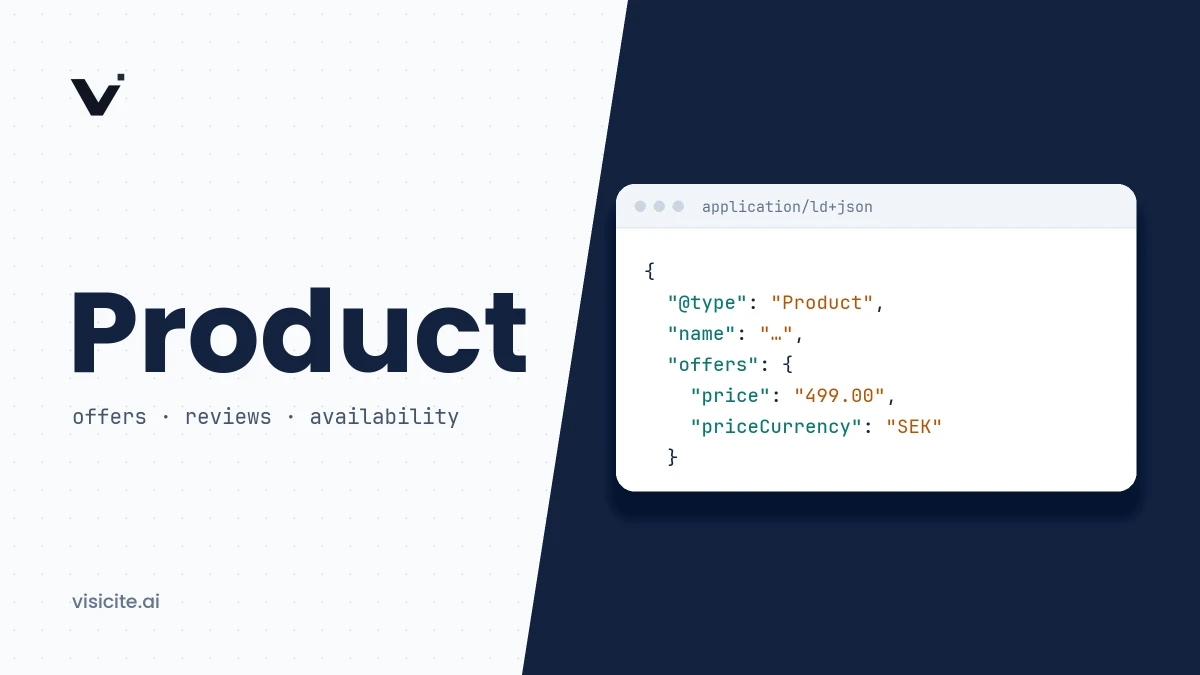
Most e-commerce platforms automatically generate basic Product schema, but auto-generated data is rarely optimized. Ensure your Product schema includes:
- name: The product name exactly as presented on the page
- description: An informative description that mirrors the page content
- brand: Brand information as a
Brandobject - offers: Current price, currency, and availability
- aggregateRating: Aggregate rating with number of reviews
- review: A selection of representative reviews
- image: Product images with correct URL and alt text
- sku / mpn / gtin: Product identifiers that increase credibility
Category Pages and ItemList Schema
Category pages are often the pages AI models reference when answering questions like "What are the best [product category] to buy?" Implement ItemList schema on category pages to clarify the hierarchy and content for AI crawlers.
Combine this with well-written editorial content at the top of the category page – an introduction that explains what the category contains, what factors are important to consider, and how the products differ from one another. This is precisely the content AI models look for when compiling a buying guide.
BreadcrumbList and Site Structure
AI models value context. BreadcrumbList schema helps the model understand where a product sits in your website's hierarchy, which contributes to establishing the product's category affiliation and relevance for specific search queries.
Buying Guides and Editorial Content as a GEO Engine
One of the most effective GEO tactics for e-commerce is creating dedicated buying guides as a separate content type. These are not product pages – they are informative articles that help the buyer understand a product category and make an informed decision.
Structure Buying Guides for AI Citability
A well-optimized buying guide for GEO should include:
- A clear introduction that defines what the guide covers and for whom it is relevant
- Factors to consider – a structured review of the most important decision parameters
- Explanations of technical terms relevant to the category
- Comparisons between product types (not necessarily individual products)
- Specific recommendations based on different use cases and needs
- Clear conclusions that summarize the most important points
Each section should have a clear heading formulated as a question or a statement that directly answers a buyer question. "How do you choose the right size?" is a better heading format for GEO than "Size guide."
Link Buying Guides to Product Pages
Internal linking between buying guides and relevant product pages creates a semantic connection that helps AI models understand that your products are relevant answers to the questions the buying guide addresses. Link specifically and contextually – not just to category pages, but to the specific products that fit the use cases the guide describes.
Authority and Credibility in an E-Commerce Context
AI models do not only assess content quality – they also assess the source's credibility. For e-commerce websites, which naturally have a commercial interest in the products they sell, it is especially important to build signals that communicate impartial expertise.
Demonstrate Industry Expertise
Publish content that shows you have deep knowledge of your product category, even when it does not directly lead to a sale. Articles about how to maintain, repair, or maximize the lifespan of products you sell signal expertise and build credibility that benefits the entire website in AI models' assessments.
Transparency About Product Selection and Assortment
If you explain why you have chosen to include specific products in your assortment – based on quality requirements, testing, or customer feedback – you create editorial credibility that distinguishes you from pure dropshipping operators. This type of transparency is something AI models generally value positively.
Update Content Regularly
Product categories change. New models are launched, specifications are updated, and buyer questions evolve over time. Regularly updated content – with clear information about when it was last reviewed – signals currency, which is a factor AI models take into account when choosing which sources to reference.
Technical Prerequisites for E-Commerce GEO
Beyond content and structured data, there are technical factors that are particularly relevant for e-commerce websites in a GEO context.
Handle Dynamic Content
Many e-commerce platforms render product information dynamically via JavaScript. AI crawlers, like search engine crawlers, can have difficulty correctly indexing JavaScript-rendered content. Ensure that product descriptions, prices, specifications, and reviews are available in the initial HTML response, not only via client-side rendering.
Handle Out-of-Stock and Discontinued Products
Product pages for discontinued or permanently sold-out products should either be removed, redirected to relevant alternatives, or updated with clear information about the product's status. AI models that reference a product that is no longer available create a poor user experience, which can over time affect how models value your website as a source.
Page Load Speed and Core Web Vitals
Technical performance affects how well AI crawlers can index your content and how highly search engines rank your pages – which in turn affects which pages are included in training data and retrieval indexes for AI models. E-commerce websites with many product images and third-party scripts should prioritize performance optimization as part of their GEO strategy.
Measure and Iterate Your E-Commerce GEO
GEO work for e-commerce should be measured continuously. Regularly monitor whether your products and buying guides appear in AI-generated responses to relevant purchase queries. Test manually in tools like Perplexity, ChatGPT, and Google AI Overviews with the questions your customers typically ask.
Identify which product categories and which types of questions you already appear in, and which ones where you lack presence. Prioritize GEO efforts based on business value – the categories where AI visibility has the greatest potential to influence purchase decisions should be high on the priority list.
A systematic GEO audit of your e-commerce website can help you identify the specific gaps in product descriptions, structured data, and editorial content that are holding you back from AI citability. With the right structure and the right content, e-commerce websites are well positioned to become the sources AI models reference when consumers make their purchasing decisions.