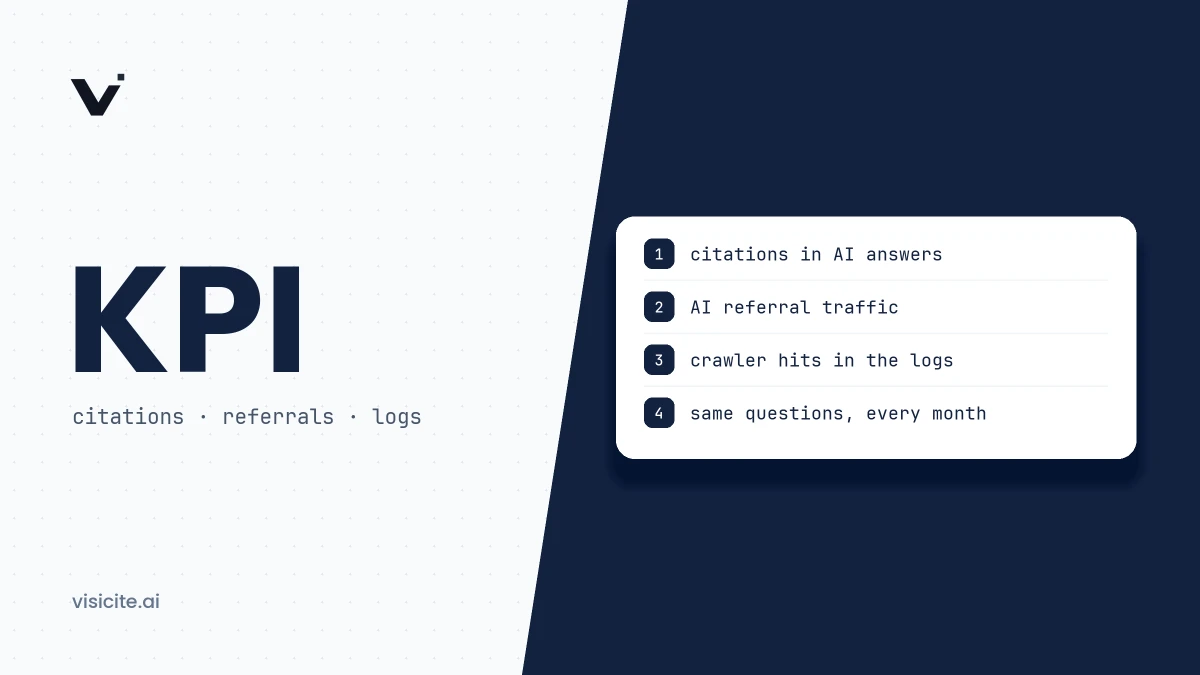

Why Measuring GEO Results Differs from Traditional SEO
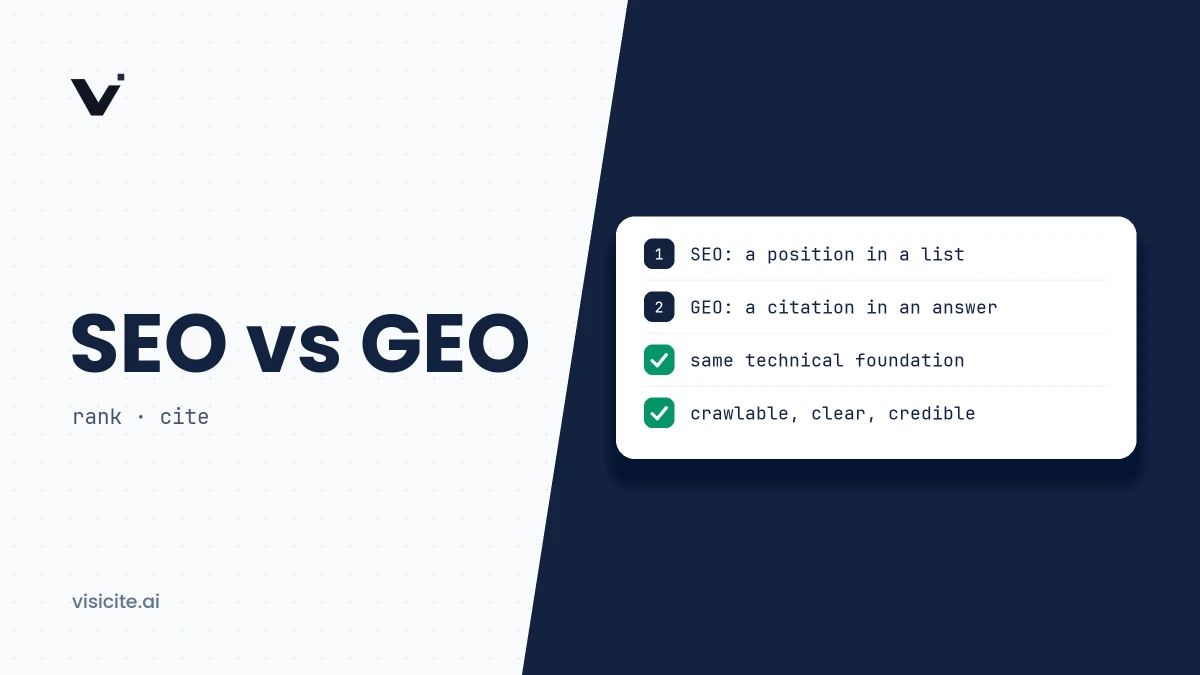
Generative Engine Optimization (GEO) is a relatively new field, and with it comes a challenge that many website owners and marketers encounter early on: how do you actually measure success? Unlike traditional SEO, where rankings, organic traffic and click-through rates are well-defined metrics supported by mature tooling, GEO measurement is still in its early stages.
There is no single "position 1" to aim for in an AI-generated answer. Instead, the goal is to be cited, referenced or implicitly included in responses from language models such as ChatGPT, Perplexity, Claude and Google Gemini. This requires a different set of KPIs and a more manual, methodical tracking process – at least until the industry develops more automated solutions.
The good news is that there are concrete things you can measure today. This guide walks through the most relevant KPIs, how to collect data and which tools can help you structure your GEO tracking.
The Most Important KPIs for GEO
Below are the KPIs that are generally considered most valuable for tracking GEO efforts. Select the ones most relevant to your business and objectives.
1. AI Citation Frequency
The primary measure of GEO success is how often your website or brand is cited as a source in AI-generated responses. This is measured by regularly posing relevant questions to various AI search engines and noting whether your website appears as a cited source.
- What you measure: Number of citations per time period, broken down by AI platform
- How you measure: Manual testing using a defined question library
- Target: Increasing citation frequency over time for priority topic areas
2. Visibility Breadth in AI Responses
Beyond direct citations, it is valuable to measure how broadly your website covers the topic areas where you want to be visible. A website that is consistently cited for a single topic is more vulnerable than one that appears broadly across its niche.
- What you measure: Number of unique topic areas in which you are cited
- How you measure: Categorise your question library by topic and track coverage
- Target: Increased breadth of topics where you are a cited source
3. Brand Mentions Without Direct Citation
AI models do not always reference a source with a link or explicit citation. Sometimes information from your website is included implicitly, or your brand is mentioned without a link to your site. These "soft" mentions are also valuable to track.
- What you measure: Frequency of brand mentions in AI responses, with and without a link
- How you measure: Manual review of AI responses to brand-related queries
4. Referral Traffic from AI Platforms
Perplexity AI and certain other AI search engines send actual referral traffic when they cite a source. This traffic is measurable in your web analytics tool and provides an objective measure of how often users actually click through from an AI response to your website.
- What you measure: Sessions and users from AI platforms as referral source
- How you measure: Filter traffic sources in Google Analytics or equivalent tool
- Sources to monitor: perplexity.ai, chat.openai.com, claude.ai, gemini.google.com
5. Content Quality Score from GEO Audits
Regular GEO audits of your website provide a structured measure of how well optimised your content is for AI citability. A GEO auditor analyses factors such as structured data, content format, authority signals and technical accessibility – and produces an aggregated score you can track over time.
- What you measure: Audit score per page and across the entire website
- How you measure: Regular audits using a standardised tool
- Target: Continuous improvement of audit scores
Building a Question Library for Systematic Testing
One of the most practical methods for measuring GEO visibility is to build a structured library of questions that your target audience is likely to ask AI search engines. These questions are then used regularly to test whether your website is cited in the responses.
How to Structure Your Question Library
- Identify core topics: Which subject areas are central to your business and content?
- Formulate 5–10 questions per topic: Include both broad and specific questions, as well as queries with purchase intent and informational intent.
- Categorise the questions: Group them by topic so you can measure coverage per category.
- Define testing intervals: Decide how frequently you will run the tests – monthly is a reasonable starting point.
- Document results in a structured way: Use a spreadsheet or dedicated tool to record which questions generated citations, on which platform and in what format.
Platforms to Test Against
Test your questions against the AI search engines most relevant to your target audience. The most common platforms to monitor include:
- Perplexity AI – Transparent with source references and sends referral traffic
- ChatGPT with web search – Large user base, cites sources when search is enabled
- Google AI Overviews – Integrated into Google Search, extremely high reach
- Claude (Anthropic) – Growing user base, relevant for B2B segments
- Microsoft Copilot – Integrated into Bing and the Microsoft 365 ecosystem
Tools for Measuring GEO Results
The market for dedicated GEO measurement tools is still developing, but a combination of existing and emerging tools can together provide a solid picture of your AI visibility.
Web Analytics: Google Analytics and Equivalents
Your existing web analytics tool is the starting point for measuring referral traffic from AI platforms. Create a dedicated segment or report that filters traffic from known AI domains. Monitor how this traffic develops over time and which pages receive it.
GEO Audit Tools
Rule-based and AI-based audit tools analyse your website against the factors that influence AI citability – structured data, content format, technical accessibility and authority signals. Regular audits provide a quantitative measure of how well optimised your website is and highlight specific areas for improvement.
Spreadsheets for Manual Tracking
For manual testing of your question library, a well-structured spreadsheet is often the most practical tool. A simple template might include columns for:
- Question
- Topic category
- Test date
- AI platform
- Cited (yes/no)
- Citation type (direct link, mentioned, implicit)
- Notes on the response
Keyword Tools for Topic Identification
Traditional keyword tools such as Google Search Console, Ahrefs or SEMrush remain useful for identifying which topics and questions your target audience searches for – and therefore which questions should be included in your GEO test library.
Establishing a Tracking Routine
Measuring GEO results is only valuable if done consistently and if it leads to action. A structured follow-up routine helps you stay on course and identify trends over time.
Monthly Follow-Up
- Run through the entire question library against priority AI platforms
- Record citation frequency and any changes
- Review referral traffic from AI platforms in your web analytics tool
- Note any new AI platforms that should be added to the test list
Quarterly Analysis
- Compare citation frequency with the previous quarter
- Analyse which pages and content types generate the most citations
- Conduct a full GEO audit to identify technical and content-related areas for improvement
- Update the question library based on new topics and trends
- Adjust content strategy based on the insights gained
Common Pitfalls in GEO Measurement
There are a number of mistakes that are common when organisations begin measuring GEO results. Being aware of them in advance saves time and produces more reliable data.
Measuring Too Infrequently
AI models are continuously updated and evolve over time. A single measurement provides a snapshot but tells you nothing about trends. Regular, consistent measurement is necessary to draw meaningful conclusions.
Using Too Few Questions
If your question library is too small, you risk missing important topic areas or drawing incorrect conclusions from an insufficient sample. Aim for at least 30–50 questions distributed across your core topics.
Only Measuring Direct Citations
Direct source references with a link are the clearest sign of GEO success, but they are not the only one. Brand mentions, implicit inclusion of information and increased referral traffic are all valuable signals that should be part of your tracking.
Not Documenting Content Changes
To understand what drives improvements in AI visibility, you need to be able to connect changes in your KPIs to concrete actions you have taken. Always document when you publish new content, update existing pages or make technical changes.
From Measurement to Action
Measurement is not an end in itself – it is a basis for decisions. Once you have established a tracking routine and begin to see patterns in your data, the next step is to translate insights into concrete actions.
If you observe that a certain type of content is consistently cited more than others, that is a clear signal that you should produce more of it. If you notice that you are cited on some platforms but not others, it may be worth investigating what distinguishes the platforms' preferences and adapting your content accordingly.
GEO measurement is fundamentally an iterative process: measure, analyse, act and measure again. With a structured approach and the right KPIs, you will progressively build a clearer picture of what works – and lay the foundation for a strategy that increases your chances of being cited by AI search engines over time.