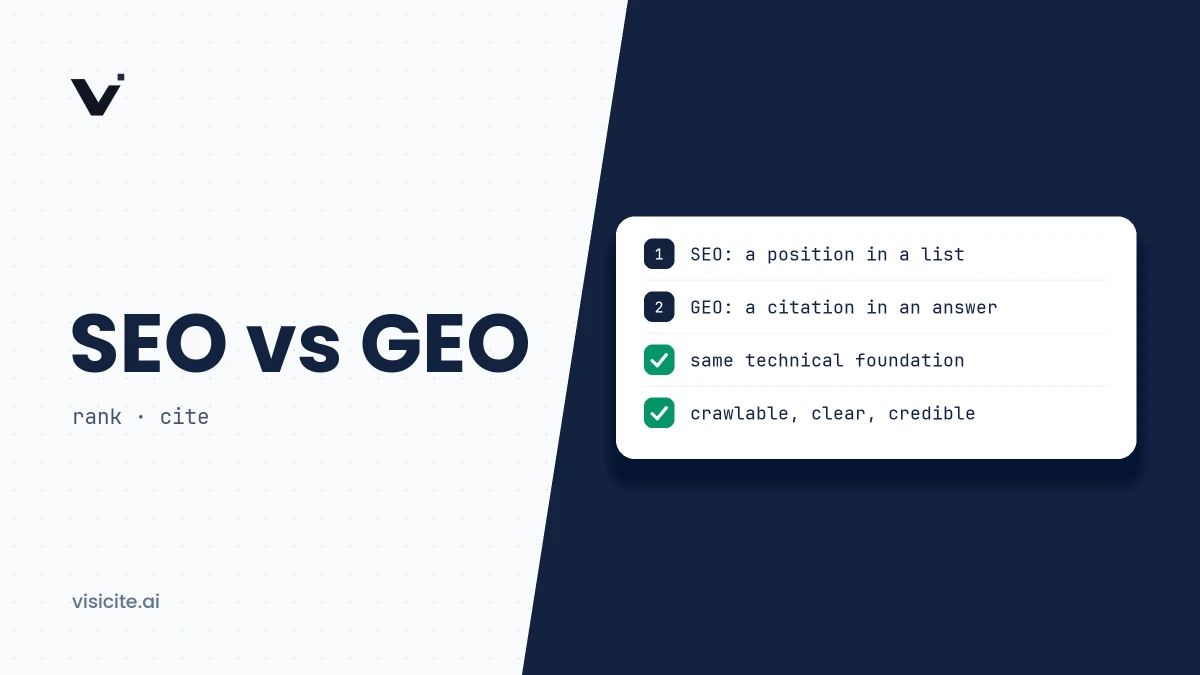

SEO is about getting a page to rank in a list of search results. GEO, generative engine optimization, is about getting your content retrieved, used and cited when an AI service such as ChatGPT, Perplexity, Claude or Google's AI Overviews composes an answer. Most of the foundation is shared: the page has to be crawlable, the content has to be good and the publisher has to be credible. The differences are in what gets retrieved (a passage rather than a page), how the result is presented (a synthesised answer with citations) and how you measure it.
In brief
- The overlap is large. Google states that SEO best practices remain relevant for AI Overviews and AI Mode, and that no special optimisations are necessary.
- What differs is the format: the AI service often runs several searches per question, extracts individual passages and weaves them into one answer with citations.
- More crawlers than Googlebot matter. OpenAI, Anthropic and Perplexity each run their own search crawlers, controlled separately in robots.txt.
- Measurement is immature. There is no stable position to track, and the tools show citations at best, not the full picture.
- You do not need a separate GEO department. You need SEO work that also checks AI crawler access, writes citable passages and tracks citations.
What the terms mean
SEO, search engine optimization, is the work of making a website easy to find, understand and rank in search engines such as Google and Bing.
GEO stands for generative engine optimization. The term was introduced in the research paper GEO: Generative Engine Optimization (Aggarwal et al., first published in November 2023 and accepted to KDD 2024). In a blog post from February 2026, Microsoft described GEO as "the practice of understanding how content participates in AI-driven experiences". The same work is sometimes called AEO, LLMO or AI SEO. We untangle the labels in the guide to GEO, AEO, SGE and LLMO, and the main guide to GEO gives the broader introduction.
What is the same
Anyone who claims GEO is an entirely new craft is wrong. Google's documentation on AI features and your website is unusually clear on three points:
- "The best practices for SEO remain relevant for AI features in Google Search (such as AI Overviews and AI Mode)."
- "There are no additional requirements to appear in AI Overviews or AI Mode, nor other special optimizations necessary." You do not need new machine readable files, AI text files or markup, and there is no special schema.org structured data to add.
- To be eligible as a supporting link, a page must be indexed and eligible to be shown in Google Search with a snippet. Indexing and serving are never guaranteed.
The same page lists what is still worth doing: allow crawling in robots.txt and in any CDN or hosting infrastructure, make content findable through internal links, provide a good page experience, make sure important content is available as text, support it with good images and video where relevant, and make sure structured data matches the visible text. In a blog post from May 2025, Google adds the advice to create "unique, non-commodity content", meaning content that could not just as well sit on a hundred other sites.
That is Google speaking about its own AI features. OpenAI, Anthropic and Perplexity have not published equally detailed guidance on how sources are selected. What they document is which crawlers they run and how to control them. The technical preconditions are the same everywhere, though: a page that cannot be fetched, or that has no readable text in its HTML, cannot be used as a source by anyone.
Credibility is common ground too. Google's guidance on creating helpful content says that E-E-A-T itself is not a specific ranking factor, but that trust is the most important part of it, and that a clear publisher, authorship information and sourcing contribute to it. More on that in the article on E-E-A-T in the AI era.
What differs
The answer is written, not listed
A search engine shows ten links and lets the user choose. An AI service reads the sources on the user's behalf and writes its own answer. Your page is not primarily competing for a click. It is competing to be one of the sources the answer is built on and refers to. The step-by-step mechanics are covered in how AI search engines work.
The unit is a passage, not a page
Citations in AI answers attach to individual stretches of text. You can see this in the vendors' own APIs. Anthropic's web search tool for Claude returns a cited_text field for each citation, containing up to 150 characters of the cited content. Google's Gemini API documentation describes citations that mark exactly which span of the answer a given URL supports. How each service splits pages internally is not documented, but the conclusion for writers is the same: a paragraph has to make sense without the rest of the page.
Compare two versions of the same information:
Hard to cite: As mentioned above, it is controlled separately, and blocking it has consequences.
Easy to cite: OAI-SearchBot is OpenAI's crawler for the search features in ChatGPT. Sites that block it in robots.txt are not shown in ChatGPT search answers, but can still appear as navigational links.
The second version names its subject and gives the whole answer in one paragraph. There are more examples in the guide to writing content AI wants to cite.
One question becomes several searches
Google says both AI Overviews and AI Mode may use what it calls query fan-out: "issuing multiple related searches across subtopics and data sources" to develop a response. The Gemini API documents that the model generates one or multiple search queries per prompt. Anthropic writes that single-fact queries typically use one to three searches, while comparative research can use ten or more. The consequence is that you can become a source for a sub-question you never targeted, which argues for covering a topic broadly rather than building one page around one keyword.
Citations instead of rankings
In a results page, positions one, two and three are distinct. In an AI answer there is no fixed list. The same question can produce different wording and partly different sources at different times, and your brand can be mentioned in the answer without your page being linked. What you can influence is the likelihood of being used, not a position.
More crawlers to keep track of
For Google Search, including AI Overviews, Googlebot is what counts. The Google-Extended token, according to Google's crawler documentation, controls training of Gemini models and grounding in other Google systems. It "does not impact a site's inclusion in Google Search" and is not a ranking signal. OpenAI's crawler documentation separates GPTBot (training), OAI-SearchBot (search in ChatGPT) and ChatGPT-User (fetches started by a user). Sites that opt out of OAI-SearchBot are not shown in ChatGPT search answers. The details, and the equivalents for Anthropic and Perplexity, are in the guide to robots.txt for AI crawlers.
Measurement
SEO has mature metrics: impressions, clicks, click-through rate and position. For GEO, this is the situation as of November 2026:
- Google: traffic from AI Overviews and AI Mode is included in the Search Console Performance report within the Web search type. Google's documentation describes no separate breakdown for the AI features.
- Bing and Copilot: Bing Webmaster Tools has offered the AI Performance report in public preview since February 2026. It shows citation counts, which pages are cited and the phrases the AI used when retrieving the content. Microsoft states that the data is a sample and says nothing about placement within an answer.
- Other services: you measure it yourself through referral traffic in web analytics, crawler visits in server logs and recurring manual or tool-assisted checks of a fixed set of questions.
The methods are covered in how to measure GEO results.
SEO and GEO side by side
| Area | SEO | GEO |
|---|---|---|
| Goal | Rank high and earn clicks | Be used and cited as a source in the answer |
| Result format | List of links and snippets | Synthesised answer with citations |
| Unit retrieved | The page | Passages from the page |
| Query | One query, one results list | Often several sub-searches per question |
| Crawlers | Search engine crawlers such as Googlebot | The same, plus OAI-SearchBot, Claude-SearchBot, PerplexityBot and others |
| Technical base | Crawlable, indexable, fast | The same, plus text present in the HTML without JavaScript |
| Content | Satisfies the search intent | The same, plus passages that stand on their own |
| Structured data | Required for rich results | Not required by Google, must match visible text |
| Metrics | Impressions, clicks, position | Citations, mentions, referral traffic |
| Measurement tools | Mature | Incomplete, partly manual |
What an SEO team should keep doing
- Technical hygiene: crawlability, indexing, canonicals, sitemaps, internal linking and load time. This is the entry ticket in both worlds.
- Content that actually answers the question and adds something of its own: first-hand data, experience, examples.
- Authority: a clear publisher, named authors, sources and mentions from other credible sites.
- Structured data where it describes what is visible on the page.
What to add
- Check AI search crawler access. Review robots.txt and your CDN or firewall settings so that OAI-SearchBot, Claude-SearchBot and PerplexityBot are not blocked by accident. Decide separately whether you want to allow training crawlers.
- Make sure the text is in the HTML. Google renders JavaScript, but states itself that "not all bots can run JavaScript". None of the other vendors' crawler pages mention rendering.
- Edit at passage level. Open each section with the answer, name the thing you are writing about rather than "it" or "this", and keep one topic per paragraph.
- Back up claims. In the 2023 GEO study, three methods had the largest effect: adding citations to sources, quotations and statistics. They produced a relative improvement of 30 to 40 percent on the researchers' visibility metric. That was an experiment on 10,000 queries against a GPT-3.5 based answer engine, not a promise of the same effect in today's products, but the direction matches what Google and Microsoft themselves advise.
- Cover the sub-questions. Because one question fans out into several searches, it pays to answer follow-up questions, comparisons and definitions within your topic.
- Measure citations. Set up Bing Webmaster Tools, segment referral traffic from AI services and follow a fixed list of questions over time.
What not to spend time on
- Treating llms.txt as a ranking factor. Google says explicitly that AI text files are not needed for its AI features. The file can be useful for agents and developer tools and is cheap to create, but it replaces nothing else. See the llms.txt guide.
- Hunting for special "AI schema". According to Google there is none. Keep the structured data you have accurate.
- Keyword stuffing. In the GEO study it offered little to no improvement, and Google's spam policies classify it as spam.
- Separate pages or hidden text aimed only at AI. Hidden text, and showing different content to users and search engines, violate the same spam policies, and you end up maintaining two versions.
- Daily "AI rankings" for single prompts. Answers vary. Trends over weeks on a fixed question list tell you more than individual data points.
How to split time and budget
There is no public data supporting a particular percentage split between SEO and GEO, and anyone quoting an exact figure is guessing. A more sensible way to think about it is that GEO is an extension of your SEO work rather than its own budget line, and that the split depends on where you stand today:
| Starting point | Prioritise |
|---|---|
| Technical gaps: pages not indexed, slow site, thin internal linking | Fix those first. That work counts in full for both SEO and GEO. |
| Solid SEO base, but unclear whether AI crawlers can reach the site | A one-off check of robots.txt, CDN, rendering and schema. Expect days, not months. |
| Good rankings but few citations | Move editorial time from new pages to rewriting your most important existing pages at passage level: answer first, sources, dates. |
| Small site with limited time | Pick the five to ten pages that matter most to the business and get them right rather than spreading the effort. |
Add a small recurring allowance for measurement. Judge traffic from AI services by what the visits lead to rather than by volume. Google gives the same advice: look at the overall value of your visits, such as sales and signups, rather than clicks alone.
Frequently asked questions
What is the difference between SEO and GEO?
SEO optimises for position in a list of search results. GEO optimises for content being retrieved, used and cited in AI-generated answers. The technology and quality requirements are largely the same. The difference is that AI services work with individual passages, often run several searches per question and show sources rather than rankings.
Does GEO replace SEO?
No. Google requires a page to be indexed and eligible to be shown with a snippet in regular search before it can be a supporting link in AI Overviews and AI Mode. Without working SEO there is nothing for GEO to build on.
If I rank well in Google, will I appear in AI answers?
Not necessarily. A good ranking shows the page is indexed and relevant, which is a precondition at Google. But the AI features run several sub-searches and select passages, so pages other than the top results for the head query can become sources. With ChatGPT, Claude and Perplexity, their own crawlers and search indexes also determine what is available.
Do I need a separate GEO strategy?
Rarely. For most organisations it is enough to extend the SEO strategy with three things: AI crawler access checks, passage-level editing and citation tracking. A separate strategy mostly creates duplicate work.
What does GEO stand for?
GEO stands for generative engine optimization. It is the work of making content easy for AI services to find, understand and cite.
Next step
Start by finding out where you stand. Visicite checks, among other things, whether AI search crawlers are allowed in robots.txt, how dependent a page is on JavaScript and whether structured data matches the visible content. The free scan covers a single URL and needs no account.