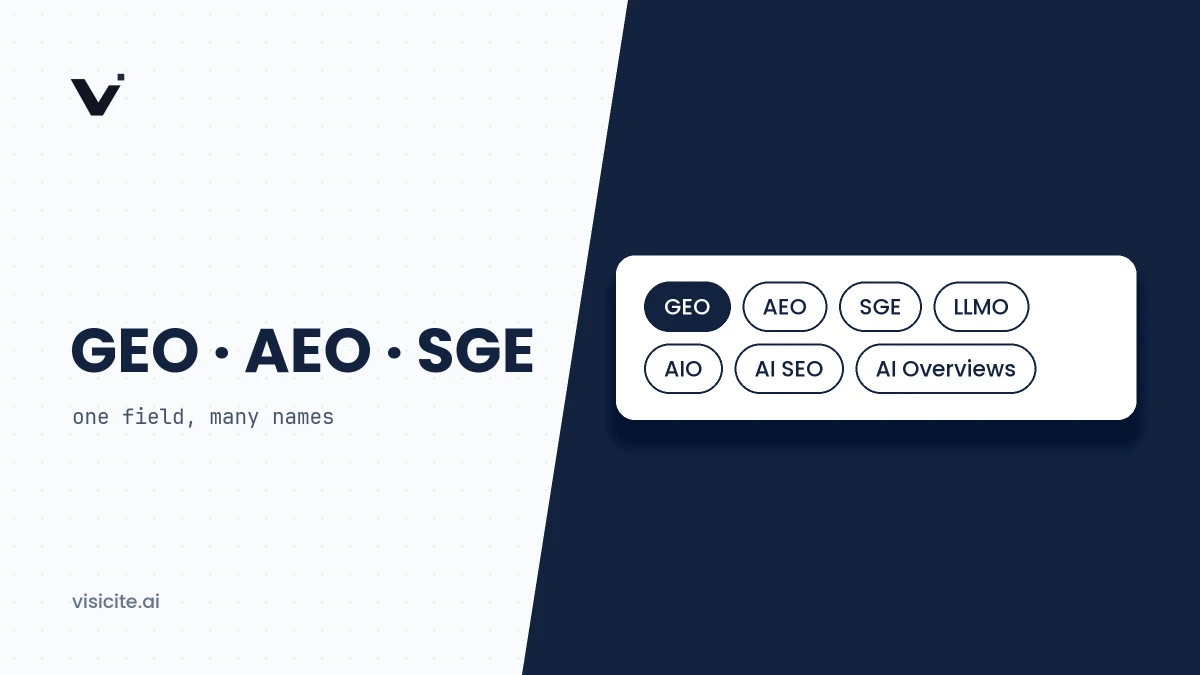

GEO, AEO, LLMO, AI SEO, AIO and AI search optimization are different names for largely the same work: making content easy to retrieve, understand and cite for AI services such as ChatGPT, Perplexity, Copilot and Google's AI Overviews. SGE is something else. It was the name of a Google experiment that started in May 2023 and has been called AI Overviews since May 2024. The differences between the terms lie in origin and emphasis, not in what you actually need to do.
In brief
- GEO (generative engine optimization) has a documented origin: a research paper from November 2023. It is also the word Microsoft uses for its tooling in Bing Webmaster Tools.
- AEO (answer engine optimization) is older and is now used as a synonym for GEO. Google itself writes "AEO/GEO".
- SGE (Search Generative Experience) is a retired product name. Say AI Overviews or AI Mode.
- LLMO, AI SEO and AIO have no clear origin or fixed definition. AIO and AI SEO are also ambiguous.
- Google regards all of it as SEO. Pick one term, define it once and spend the effort on the work.
The terms side by side
| Term | Stands for | Origin | Status today |
|---|---|---|---|
| GEO | Generative engine optimization | Research paper by Aggarwal et al., arXiv November 2023, KDD 2024 | Established. Used by Microsoft, among others. |
| AEO | Answer engine optimization | The SEO industry, before generative search. No documented first use. | Established, in practice a synonym for GEO. |
| SGE | Search Generative Experience | Google's Search Labs experiment, announced 10 May 2023 | Retired product name. Replaced by AI Overviews. |
| LLMO | Large language model optimization | Industry term of unknown origin | In use, less common. |
| AI SEO | SEO for AI search, or SEO done with AI | Informal expression | Common but ambiguous. |
| AIO | AI optimization, or shorthand for AI Overviews | Industry term of unknown origin | Ambiguous. Avoid without explanation. |
| AI search optimization | A descriptive phrase | Plain usage | Understandable without explanation. |
GEO: generative engine optimization
GEO is the only one of these terms that can be traced to a specific source. It was introduced in the paper GEO: Generative Engine Optimization, posted to arXiv on 16 November 2023 and accepted to the KDD 2024 conference. The authors, affiliated with Princeton University and IIT Delhi among others, use "generative engine" as a collective name for search services in which a language model writes an answer from several sources.
The word has since been picked up by vendors too. When Microsoft launched AI Performance in Bing Webmaster Tools in February 2026, it described the release as an early step toward "Generative Engine Optimization (GEO)" tooling.
GEO has one drawback: "geo" is also short for geography, as in geotargeting and geolocation. Spell the term out on first use. If what you mean is AI visibility for local businesses, that is covered in our article on local GEO. What GEO involves in practice is covered in the main guide to GEO.
AEO: answer engine optimization
AEO means optimizing for answer engines, services that give an answer rather than a list of links. The term was in use in the SEO industry before ChatGPT and the other generative services existed, mainly in connection with direct answers in search results and with voice assistants. Several people are credited with coining it, but we have not found a first use that can be checked, so we do not name one.
Today AEO is used for the same thing as GEO. People who say AEO sometimes put the emphasis on writing short, direct answers to concrete questions, while GEO is more often used for the whole picture, including crawlers, citations and measurement. That is a nuance of usage, not a settled definition. Google treats the two as a pair: its guide to optimizing for generative AI features mentions "AEO" and "GEO" in the same breath.
SGE: the experiment that became AI Overviews
SGE is not an optimization method but a product name. This is the timeline according to Google's own posts:
| Date | Event |
|---|---|
| 10 May 2023 | Google announces SGE, Search Generative Experience, as an experiment in Search Labs. It opens first in the US and in English. |
| 14 May 2024 | AI Overviews begin rolling out to everyone in the US. The post describes the feature as something that had been tested in Search Labs. |
| 28 October 2024 | AI Overviews expand to more than 100 countries and territories. |
| 5 March 2025 | AI Mode is introduced as a new Labs experiment. |
| 20 May 2025 | AI Mode starts rolling out in the US with no Labs sign-up required. The same day, Google says AI Overviews are available in over 200 countries and territories and more than 40 languages. |
Anyone writing "optimize for SGE" in 2026 is using a name Google itself left behind in 2024. The current names are AI Overviews and AI Mode. For both, Google says the basic requirement is the same as for ordinary search results: the page must be indexed and eligible to be shown with a snippet. How these features retrieve and select sources is described in How AI search engines work.
LLMO: large language model optimization
LLMO means optimizing for large language models. We have not found a documented origin for the term. It shifts the focus from the search service to the model itself, and is sometimes used for the ambition of influencing what the model "knows" about a brand from its training, not only what it retrieves during a search.
The distinction between those two routes is real and worth understanding. What a model retrieves from the web at the moment of asking can be influenced through access, structure and content. What it learned during training cannot be changed after the fact, and how any single website is weighted is not public. You do not need a separate acronym to keep the two apart.
AI SEO and AIO: two ambiguous terms
AI SEO can mean two different things: search engine optimization for AI-driven search services, or search engine optimization carried out with AI tools. The first is the same thing as GEO. The second is about working methods and has nothing to do with AI visibility. If you use the expression, say which meaning you intend.
AIO is used both as an abbreviation of "AI optimization" and as industry shorthand for AI Overviews. "We lost traffic because of AIO" and "we need to work on AIO" refer to entirely different things. The abbreviation is hard to defend when clearer options exist.
AI search optimization is not a technical term but a description. That is its strength: it needs no explanation and works well in headings and in conversations with people outside the industry.
What the vendors themselves call it
Google uses none of the acronyms for its own guidance and instead talks about optimizing for generative AI features in Search. In its May 2026 guide it writes that, from Google Search's perspective, optimizing for generative AI search is optimizing for the search experience, "and thus still SEO". The same guide advises against what it calls "AEO/GEO hacks", such as chunking content or creating special AI text files for Google's benefit, and points anyone considering third-party AEO or GEO services to Google's guidance on evaluating third-party advice.
Microsoft, as noted, uses GEO for its Bing Webmaster Tools features. The difference in vocabulary says something about the state of things: there is no shared terminology even among the companies building the services. Note also that Google's statements concern Google Search, not how other AI services work.
Which term should you use?
| Situation | Recommendation |
|---|---|
| You are writing for marketers and SEO specialists | GEO, spelled out as generative engine optimization on first use |
| You are talking to management or clients outside the industry | "Visibility in AI answers" or "AI search optimization" |
| You mean Google's features specifically | AI Overviews and AI Mode, not SGE and preferably not AIO |
| You mean using AI tools in SEO work | Say so, for example "AI-assisted SEO" |
| The client or agency says AEO or LLMO | Use their word and confirm that you mean the same thing |
We use GEO at Visicite for two reasons: the term has a source that can be checked, and it is not tied to a single product. That does not make the other terms wrong.
Does it matter in practice?
No. The work is the same whatever the label: make sure the search bots can reach the content, answer concrete questions clearly, support claims with sources and make it clear who is behind the content. Do be wary when a new acronym is presented as a new discipline with secrets of its own. None of the terms describes a technique the others lack.
How GEO relates to classic search engine optimization is covered in SEO vs GEO. More terms, from grounding to query fan-out, are in the GEO glossary, and if you want to move from words to action, the GEO checklist is the place to start. You can also run a free GEO scan of a single page to see how it holds up.
Frequently asked questions
Are GEO and AEO the same thing?
In practice, yes. AEO is the older term and GEO comes from a 2023 research paper, but today they are used for the same work. Google writes "AEO/GEO" as a pair and counts both as SEO.
Does SGE still exist?
Not under that name. SGE was a Search Labs experiment announced in May 2023. The feature launched broadly in the US as AI Overviews in May 2024, and according to Google it has been available in over 200 countries and territories since May 2025.
What does LLMO stand for?
Large language model optimization. The term has no fixed definition and is used roughly as GEO is, sometimes with an emphasis on what the model learned during training.
What does AIO mean?
It depends on context. AIO can mean "AI optimization", roughly GEO, but it is also used as shorthand for Google's AI Overviews. Ask which meaning is intended.
Is GEO just SEO with a new name?
To a large extent, and Google says so outright about its own search engine. What is added is the AI services' own crawlers in robots.txt, more weight on individual passages being clear and supported, and different ways of measuring. If you already do good SEO, you have done most of the work.