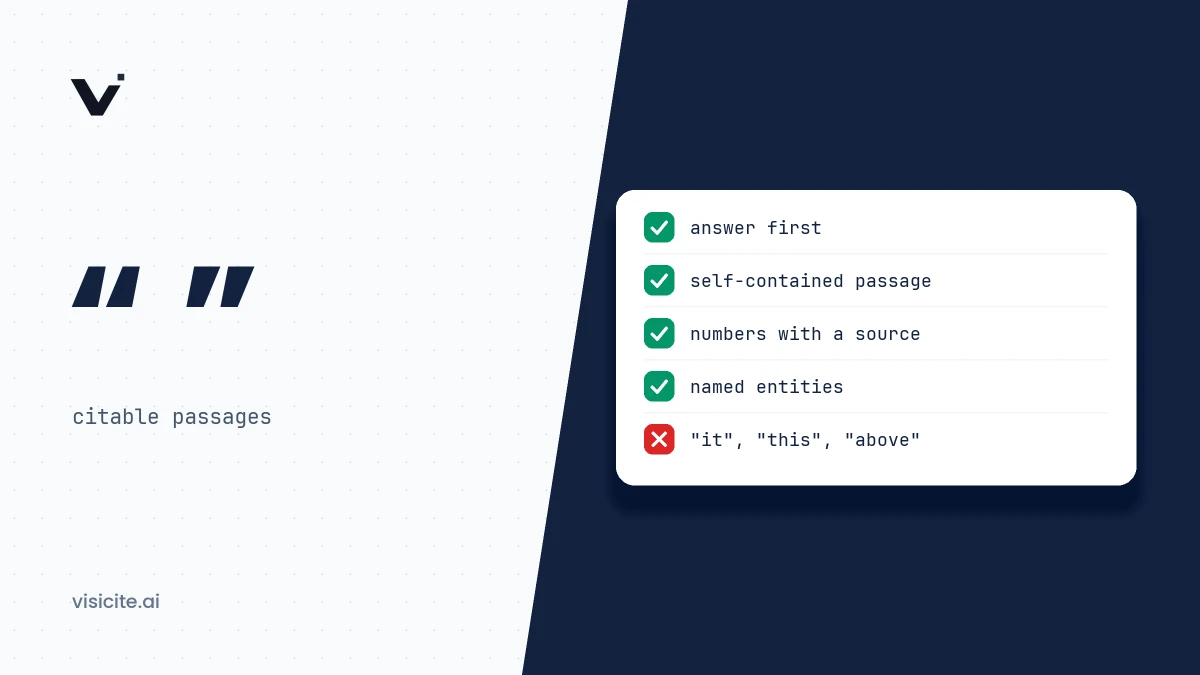

Content is citable by AI answer engines when a single passage can be lifted out of the page and still be clear, accurate and checkable. In practice that means answering directly under each heading, naming what you refer to instead of pointing back to earlier text, and giving every number a source and a year. No writing technique guarantees a citation, but the same habits make the text better for human readers, and those are the readers Google tells you to write for.
In brief
- AI citability is how easily a passage can be retrieved, understood without its surroundings and verified.
- Answer first, explain second. The first two sentences under a heading should stand on their own.
- In the original GEO paper (Aggarwal et al., KDD 2024), adding citations, quotations and statistics raised visibility by 30 to 40 percent in a benchmark setting. Keyword stuffing did almost nothing.
- Google states that you do not need to rewrite or chunk content for AI. Unique content with a clear structure matters most.
- Never invent numbers or quotes to look citable. A claim nobody can verify is a liability, not an asset.
How do AI citations work?
An AI service with web search first retrieves a set of pages, reads the passages relevant to the question, and then writes an answer with links to the pages that support it. Google describes the technique as retrieval-augmented generation: its core ranking systems retrieve current pages from the Search index, and the model writes the response from what those pages say. Google may also issue several related searches for one question, which it calls query fan-out. The details are in Google's guide to generative AI features in Search.
What gets cited is a short passage, not a whole page. In Anthropic's web search API, for example, each citation carries the page URL, the title and up to 150 characters of cited text, according to Anthropic's documentation. Perplexity states that each answer includes numbered citations linking to the original sources. The full pipeline is explained in our guide to how AI search engines work.
The consequence for writers: every paragraph should be able to stand alone. A paragraph that only makes sense after reading the three before it is hard to use as evidence.
What does the research say about citations, quotations and statistics?
The study that gave GEO its name is GEO: Generative Engine Optimization by Pranjal Aggarwal and colleagues, posted to arXiv in November 2023 and accepted to the KDD 2024 conference. The researchers built a benchmark called GEO-bench with 10,000 queries and tested nine ways of rewriting a source text. They then measured how much of the generated answer drew on the rewritten source.
| Change to the text | Result in the paper |
|---|---|
| Adding citations, quotations from credible sources, or statistics | 30 to 40 percent higher visibility on position-adjusted word count, 15 to 30 percent on subjective impression |
| Making the text more fluent and easier to understand | 15 to 30 percent higher visibility |
| Writing in a more persuasive, authoritative tone | No significant improvement |
| Adding more keywords from the query | Little to no improvement |
Two further findings are worth knowing. The effect was largest for sources that ranked low in Google: for the source in fifth position, adding citations raised visibility by 115 percent, while the source in first position lost 30 percent. And the best-performing method varied by subject area.
The limits you should know about
- It is a benchmark, not a live product. Answers were generated by GPT-3.5 Turbo from the top five Google results per query. Current services use different models and retrieve sources differently.
- Visibility is not traffic. The metrics count words and position in the answer, not clicks or customers.
- A language model did the rewriting from a prompt. The study measures whether the source became more visible, not whether what was added was true. On a real website, every figure and every quote has to be genuine.
- The test against a real service was small. On Perplexity the authors tried 200 queries with the source texts uploaded as files. The best methods there improved results by 22 and 37 percent, depending on the metric.
- The authors themselves note that the methods may need to adapt as generative engines evolve, and that they did not measure the effect on ordinary search rankings.
A reasonable reading: evidence and concrete detail make a text more useful as a source, while tone and keyword density do not. That is a direction to work in, not a promise of 40 percent. We cover later studies in our overview of GEO research.
What do Google and Microsoft say?
Google is explicit that there are no special requirements for AI Overviews and AI Mode. Its documentation on AI features says a page must be indexed and eligible to be shown with a snippet, and that existing SEO best practices still apply. In its generative AI guide, last updated in July 2026, Google goes further and dismisses some common advice:
- You do not need to break content into tiny pieces for AI to understand it. There is no ideal page length.
- You do not need to write in a specific way for AI. The systems understand synonyms and meaning.
- What Google says will likely matter most in the long run is unique, non-commodity content, such as a review based on first-hand experience instead of a summary of what others have written.
- Content should be organised in paragraphs and sections, with headings that give a clear structure, for the reader's sake.
Microsoft is more hands-on in an article from the Bing team in October 2025: AI assistants do not read a page top to bottom but break it into smaller pieces that are ranked and assembled into answers. Microsoft recommends clear headings, questions with direct answers, lists and tables, and sentences that make sense when pulled out of context. It also says that nothing guarantees selection.
Read carefully, the two messages agree. Do not write a special AI version of your text. Write a clear text for people, where each section has one subject and one answer. That is the kind of text the principles below describe.
Ten writing principles, with examples
1. Answer first, explain second
Put the answer in the first two sentences under the heading. Background, caveats and depth come after.
Before: Many savers wonder how interest really works over time. There are several factors to consider, and in this section we will take a closer look at a concept that comes up often.
After: Compound interest means you earn interest on the interest you have already earned. At 5 percent annual interest, 10,000 dollars grows to about 16,289 dollars in ten years, compared with 15,000 dollars if interest is paid on the original amount only.
2. Make every passage self-contained
Replace "it", "this", "as mentioned above" and "in that case" with the thing you actually mean. The test is simple: paste the paragraph into an empty document and see whether an outsider understands it.
Before: As mentioned above, it needs to rest longer in that case. This is because of the temperature.
After: Sourdough ferments more slowly the colder it is kept. A dough that rises in the fridge therefore needs more time than a dough that rises at room temperature.
3. Phrase headings as questions when the reader has a question
A heading should say which subject the section covers. "How often should a ground source heat pump be serviced?" says more than "Service". Use the question form where it is natural, not everywhere, and let the first sentence under the heading answer it. The same pattern in its purest form is covered in our guide to FAQ pages.
4. Define terms precisely
A definition should contain the term, what it is, and what separates it from neighbouring things. Avoid metaphor where the reader needs a rule.
Before: Leap years are something that comes around every so often to keep the calendar in line.
After: A leap year is a year with 366 days instead of 365. In the Gregorian calendar, a year is a leap year if it is divisible by 4, except for century years that are not divisible by 400. The year 2000 was a leap year, 1900 was not.
5. Give numbers a source and a date
A number without a source cannot be checked, and a number without a year cannot be weighed. State who measured, what was measured and when, and link to the original.
Before: Studies show that statistics boost visibility in AI answers considerably.
After: In the paper GEO: Generative Engine Optimization (Aggarwal et al., KDD 2024), adding statistics, quotations or citations raised a source's visibility by 30 to 40 percent in a benchmark of 10,000 queries.
6. Add original data and first-hand experience
The only content nobody else can publish is what you have measured, tested or lived through yourself. Describe the method: how many, over what period, how you counted. Write "we tested twelve models over four weeks" only if it is true, and show the evidence. Google singles out the first-hand perspective as what separates valuable content from content anyone could have produced.
7. Compare in tables
When two or more options are compared on the same points, the data belongs in a table with clear column headings. State the unit and keep each cell understandable on its own.
| After | Simple interest | Compound interest |
|---|---|---|
| 1 year | $10,500 | $10,500 |
| 5 years | $12,500 | $12,763 |
| 10 years | $15,000 | $16,289 |
The table shows 10,000 dollars at 5 percent annual interest. Always put an explanatory sentence like that next to the table, so the figures keep their premise if the table is lifted out.
8. Use lists and numbered steps
Number things that must be done in order and use bullets for items of equal weight. Each item should be a complete thought. "Switch off the power to the heat pump before opening the cover" is usable. "The power" is not. Reasoning that flows should stay as prose. A list of loose fragments is worse than a good paragraph.
9. Name entities unambiguously
Write out the full names of companies, products, people, places and versions the first time they appear in each section. Vague references make it impossible to tie the claim to the right thing.
Before: They updated the guidelines last year and added a letter.
After: Google added Experience to its Search Quality Rater Guidelines on 15 December 2022. E-A-T became E-E-A-T.
10. Keep content fresh and dated
Show a visible date for publication and for the latest update, and write "in November 2026" instead of "recently". Google's advice on dates is to show the date prominently on the page, label it with text such as "Published" or "Last updated", and make it match datePublished and dateModified in the page's structured data. Never change the date without changing the content. Google lists exactly that as a warning sign in its self-assessment questions. How to mark up dates and authors is covered in our guide to JSON-LD and structured data.
Pre-publish checklist
- Do the first two sentences answer the page's main question?
- Does every section open with its answer?
- Can every paragraph be understood without the paragraphs around it?
- Does every heading say what its section is about?
- Does every number have a linked source and a year?
- Are all quotes verbatim and attributed to the right person?
- Is there something on the page only you can contribute: your own data, tests or experience?
- Are companies, products and people written out with their full names?
- Are the author, the publication date and the update date visible?
- Does the structured data match what is visible on the page?
The points about authors and publisher identity are developed in our guide to E-E-A-T and AI answers, and a broader site-wide review is in the GEO checklist. Visicite's audits cover heading structure, question headings, paragraph length and freshness, among other things. To see how a single page holds up, you can run a free scan of one URL with no account.
Frequently asked questions
What is AI citability?
AI citability is a measure of how well a piece of content works as a source in an AI-generated answer. A citable passage can be technically retrieved, makes sense without the rest of the page, contains a concrete claim and can be backed up with a source and a date. The term is a working definition within GEO, not a metric published by any AI vendor.
How does AI choose which sources to cite?
No vendor has published a complete list of criteria. What is documented is that the services first retrieve pages through search and then let the model use the passages that answer the question. For Google's AI features, the page must be indexed and eligible to be shown with a snippet. We go through what is known and unknown in our article on how language models choose sources.
Do I have to rewrite all my content for AI?
No. Google says you do not need to write in a specific way for generative AI search. Start with the pages that already answer common questions and make sure the answer comes first, the paragraphs stand alone and the numbers have sources. That is ordinary editing, not a new kind of text.
How long should a paragraph be?
There is no documented ideal length, for paragraphs or for pages. A useful rule of thumb is one subject per paragraph: when the subject changes, start a new one. Long blocks of text without headings make it harder to see where an idea starts and ends, for readers and machines alike.
Do citations increase the chance of being cited?
In the GEO paper's benchmark they did, most clearly for sources that ranked low. It has not been shown that the effect is as large in current services. Citations do always make a text checkable, which is reason enough to use them.