
Yes, E-E-A-T is still relevant, but not as a score you can optimise. E-E-A-T stands for Experience, Expertise, Authoritativeness and Trust, and it is the framework Google's quality raters use to judge whether a page can be trusted. Google states plainly that E-E-A-T is not a specific ranking factor. At the same time, Google's AI answers are built on the same ranking systems as ordinary search, so what makes a publisher credible to a reader is also what makes a page usable as a source.
In brief
- E-E-A-T comes from Google's Search Quality Rater Guidelines. Trust is the most important part, and the other three support it.
- There is no E-E-A-T score. Rater assessments do not affect how individual pages rank.
- That AI services outside Google weigh authorship or schema markup when choosing sources is not documented. It is a reasonable inference, not an established fact.
- What you can do is concrete and verifiable: named authors, a clear publisher identity, primary sources, first-hand evidence, dates, and the same facts about your organisation everywhere.
- Invented authors, false credentials and schema that does not match the page do harm, not good.
What is E-E-A-T?
E-E-A-T is four qualities that Google's quality raters weigh when they assess the quality of a page. The definitions are in section 3.4 of the Search Quality Rater Guidelines, whose current version as of November 2026 is dated 11 September 2025. The first E, Experience, was added on 15 December 2022. Before that the framework was called E-A-T.
| Part | What the rater considers | Example from the guidelines |
|---|---|---|
| Experience | Whether the creator has first-hand or life experience of the topic | A product review by someone who has personally used the product |
| Expertise | Whether the creator has the knowledge or skill the topic requires | Home rewiring advice from a skilled electrician |
| Authoritativeness | Whether the creator or the website is known as a go-to source for the topic | The official government page for renewing a passport |
| Trust | Whether the page is accurate, honest, safe and reliable | An online store with secure payment and reliable customer service |
Trust sits above the rest. The guidelines say an untrustworthy page has low E-E-A-T no matter how experienced or expert its creator seems. They give a blunt example: a financial scam is untrustworthy even if the scammer is highly experienced at running scams.
The bar also varies by topic. For topics that could affect people's health, finances or safety, which Google calls Your Money or Your Life (YMYL), the requirements are higher than for entertainment or hobby subjects.
How do raters assess E-E-A-T?
According to the guidelines, raters draw on three things:
- What the website and the creator say about themselves, starting with the About page and the creator's profile page.
- What others say: independent reviews, references, news articles and other credible sources.
- What is visible on the page itself, meaning whether the content demonstrates experience and knowledge.
Where the website's own account and independent sources disagree, raters are told to trust the independent sources. That is why your own website is only half the job.
Is E-E-A-T a ranking factor?
No. In its guidance on helpful, reliable, people-first content, Google writes that E-E-A-T itself is not a specific ranking factor. Its automated systems do try to identify a mix of factors that characterise content with good E-E-A-T, and for YMYL topics Google says the systems give even more weight to such content.
Quality raters do not steer rankings either. Google writes that raters have no control over how pages rank and that rater data is not used directly in its ranking algorithms. The ratings are used to evaluate whether the systems are working, in the way a restaurant uses feedback cards from diners. Google repeated the point when it introduced the extra E in 2022.
In practice this means three things:
- No tool can measure your E-E-A-T score, because there is none.
- No single action "adds E-E-A-T".
- The guidelines are still useful, because they describe what Google is trying to get its systems to reward.
Do trust signals matter for AI answers?
Probably yes, but the evidence is stronger for some services than for others. It is worth separating what vendors have actually said from what is inferred.
| Claim | Status |
|---|---|
| Google's AI Overviews and AI Mode are rooted in Google's core Search ranking and quality systems | Documented by Google |
| A page must be indexed and eligible to be shown with a snippet to appear as a link in Google's AI answers | Documented by Google |
| No special schema markup is required for Google's AI features | Documented by Google |
| Perplexity searches sources that the company describes as authoritative | Stated by Perplexity, without explaining how sources are selected |
| ChatGPT, Claude and Perplexity read author pages or Person schema when choosing sources | Not documented |
| A page with a clear publisher, sources and dates is easier to use as evidence | Reasonable inference, partly supported by research |
The strongest evidence concerns Google. In its guide to generative AI features in Search, Google writes that the AI features are rooted in its core Search ranking and quality systems and that responses are built on pages retrieved from the Search index. What Google says about E-E-A-T in ordinary search should therefore carry over to the choice of sources for AI answers. According to the documentation on AI features, there are no additional technical requirements.
For other services the picture is thinner. They retrieve pages through web search, so a page that cannot be found in search will presumably seldom make the selection. But none of them has published how credibility is assessed. Perplexity's help centre, for example, says it searches authoritative sources but does not define the term. Research offers a clue: in the original GEO paper (Aggarwal et al., KDD 2024), adding citations, quotations and statistics raised a source's visibility in a benchmark, while a more authoritative tone produced no significant effect. What can be checked appears to count for more than what merely sounds confident. More on selection in our article on how language models choose sources.
The conclusion is practical. The measures below cost little, are true whichever AI service is reading, and help people decide whether to trust you. That is reason enough.
Seven concrete, verifiable measures
1. Name the author and give them an author page
Google asks three questions in its guidance: is it self-evident who authored the content, do pages carry a byline where one would be expected, and does the byline lead to more information about the author and the areas they write about? A good author page contains:
- full name and current role
- credentials that can be checked: education, licence, certification, previous employers
- which topics the person writes about and why they know them
- links to profiles on other sites where the same person appears
- a list of the person's articles
Never invent an author. Google specifically names fabricated creator profiles with AI-generated headshots, made-up names or false credentials as deceptive.
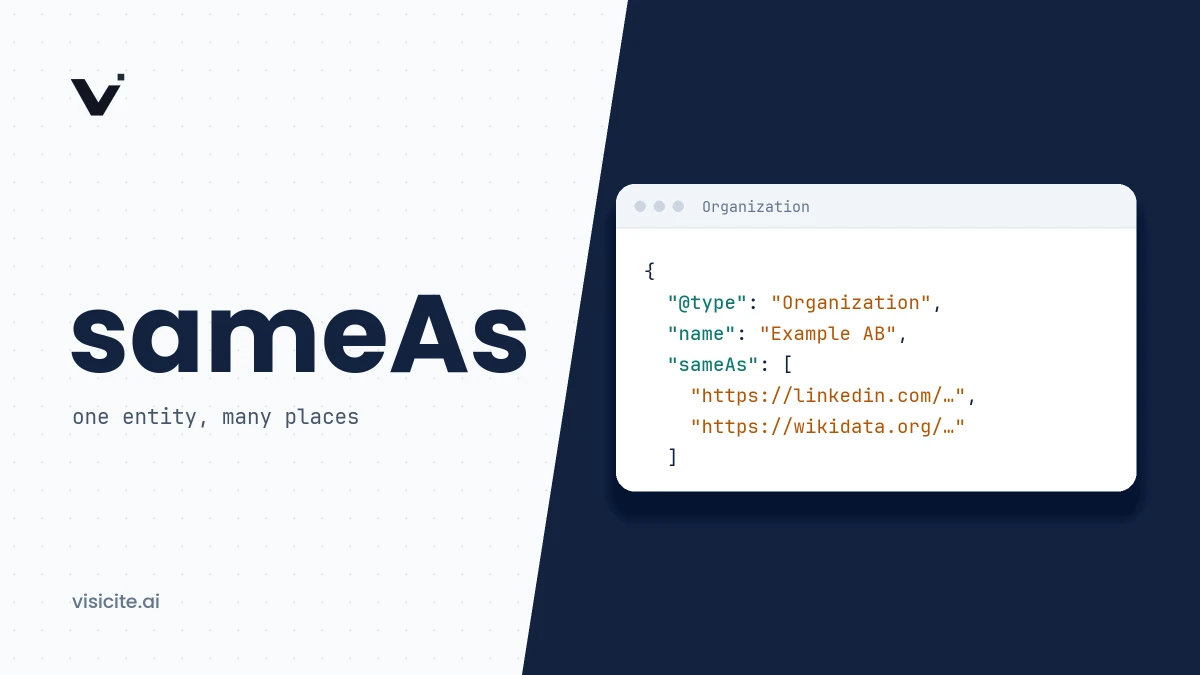
2. Mark up the person and the organisation with schema and sameAs
Schema markup makes it unambiguous who the author and the publisher are. The sameAs property is defined by schema.org as the URL of a reference web page that unambiguously indicates the item's identity, such as a profile on another website. In its Article documentation, Google recommends that you:
- include every author shown on the page, each in its own
authorfield - use the
Persontype for people and theOrganizationtype for organisations - put only the name in
author.name, with no job title, publisher name or "posted by" - add
urlorsameAspointing to a page that identifies the author
For the company, Google recommends Organization markup on the home page or an About page, with properties such as name, logo, address, contact details, sameAs and, where applicable, legalName and vatID.
Two caveats. Schema should describe what is visible on the page, not replace it: Google's structured data guidelines say you should not mark up content that is not visible to readers. And Google writes that structured data is not required for its AI features. Markup is a way of being clear, not a shortcut. The technique is covered in our guide to JSON-LD and structured data.
3. Make it clear who is behind the website
The rater guidelines say it should be clear who is responsible for the website and who created the content. How much contact information is needed depends on the type of site: the guidelines call it extremely important for websites that handle money, such as stores and banks.
Put the organisation's registered name, postal address, email address and, where relevant, company registration and VAT numbers on an About or Contact page that is linked from every page. Publish them as text, not as an image.
4. Cite primary sources
Link to the original: the authority, the legal text, the study or the manufacturer's documentation, not someone's summary of it. State who says what and which year the figure refers to. Then both the reader and an AI service can check the claim. How to write such passages is shown with examples in our guide to writing content AI can cite.
5. Show first-hand experience with evidence
Experience shows in details only someone who has done the thing would know. Show your own measurements and how they were made, your own photos and screenshots, what went wrong and what you changed. Google describes the difference this way: a first-hand review provides a unique perspective, while a summary of existing content simply restates what is already available. Never claim experience you do not have.
6. Date the page and show its update history
Show when the page was published and when it was last changed, and make the dates match datePublished and dateModified in the page's schema. That is Google's recommendation on dates. For content where facts change, it pays to say what changed, for example "Updated 19 October 2026: new fees for 2027". Do not change the date without changing something substantial.
7. Be the same entity everywhere
Use exactly the same company name, address, web address and personal names on the website, in schema, in business registers and on profiles with other services. If the company is "Example Plumbing Ltd" in one place and "Example Plumbers" in another, it becomes harder to tell that they are the same publisher. Point to the official profiles with sameAs.
What others say about you, meaning mentions, reviews and references, cannot be arranged on your own website. Chasing inauthentic mentions is, according to Google, not as helpful as it might seem. How to build that kind of trust for real is covered in our guide to digital authority.
Example: Article with author and publisher in JSON-LD
The example shows an article with a named author, a publisher and dates. Replace every address with your own. The sameAs links must go to real profiles that belong to the person and the company, and all the details must also be visible on the page.
<script type="application/ld+json">
{
  "@context": "https://schema.org",
  "@type": "Article",
  "headline": "How to descale a water heater",
  "description": "Step by step: how to descale a water heater and how often it is needed.",
  "inLanguage": "en",
  "mainEntityOfPage": "https://www.example.com/guides/descale-water-heater",
  "image": ["https://www.example.com/images/descaling-16x9.jpg"],
  "datePublished": "2026-03-04T08:00:00+00:00",
  "dateModified": "2026-10-19T09:30:00+01:00",
  "author": {
    "@type": "Person",
    "@id": "https://www.example.com/authors/anna-lind#person",
    "name": "Anna Lind",
    "url": "https://www.example.com/authors/anna-lind",
    "jobTitle": "Plumbing and heating engineer",
    "worksFor": { "@id": "https://www.example.com/#organization" },
    "sameAs": ["https://profiles.example.org/anna-lind"]
  },
  "publisher": {
    "@type": "Organization",
    "@id": "https://www.example.com/#organization",
    "name": "Example Plumbing",
    "legalName": "Example Plumbing Ltd",
    "url": "https://www.example.com/",
    "logo": "https://www.example.com/images/logo.png",
    "sameAs": ["https://directory.example.net/example-plumbing"]
  }
}
</script>
The dates include a time zone offset, here UK time: +00:00 in March and +01:00 during summer time in October. Check the code with a validation tool before you publish.
What does not help
- Writing "E-E-A-T optimised" or "reviewed by experts" without saying who the expert is.
- A more confident tone. In the GEO paper, a more authoritative style produced no significant effect.
- Schema that does not match the page, such as an author in the code who is not shown to the reader.
- Bought or arranged mentions. Google writes that seeking inauthentic mentions is not as helpful as it might seem, and that its AI features depend on its spam-blocking systems as well as its ranking systems.
- Mass-produced pages for every conceivable search variation. Google writes that this violates its scaled content abuse policy when the main purpose is to manipulate rankings or AI responses.
More pitfalls are in our rundown of common GEO mistakes.
Frequently asked questions
Is E-E-A-T still relevant?
Yes. E-E-A-T remains in Google's quality rater guidelines, and Google writes that its systems try to identify content that demonstrates experience, expertise, authoritativeness and trustworthiness. Because Google's AI answers are built on the same ranking systems, the framework is relevant there too. What has changed is that more systems than search engines now need to work out who stands behind a claim.
Is E-E-A-T a Google ranking factor?
No. Google writes that E-E-A-T itself is not a specific ranking factor, and there is no score to measure. Google's systems do use a mix of factors intended to surface content with good E-E-A-T, especially on topics involving health, finances and safety.
What does E-E-A-T stand for?
Experience, Expertise, Authoritativeness and Trust. According to Google, trust is the most important of the four, and the other three contribute to it.
Do I need schema markup to be cited by AI?
No. Google writes that structured data is not required for its generative AI features, and no other vendor has documented such a requirement. Schema is still a good way to state the author, publisher and dates unambiguously, provided the same details are visible on the page.
Do I need to disclose that content was written with AI?
Google recommends explaining how content was produced when readers would reasonably wonder, for example when automation was used. Google phrases this as a recommendation, not a requirement. The legal requirements that apply in the EU are covered in our guide to labelling AI-generated content.
Visicite checks, among other things, for an identifiable publisher, named authors, external sources and consistent use of the organisation's name. You can try it with a free scan of one URL, with no account.