
None of the major AI providers has published a list of the authority signals that decide which sources their AI answers cite. Google and Microsoft point to the same ranking and quality systems used in regular search, where links and trustworthiness are documented as factors. OpenAI, Anthropic and Perplexity mainly document how to grant or deny access. Research mostly shows what affects visibility in test environments and how models weigh texts they have already been given, not how links or E-E-A-T are weighted in production systems.
Summary
- Google says AI Overviews and AI Mode are built on Google's search systems. Pages that are indexed and eligible to be shown with a snippet can appear as a source, and Google states that there are no additional technical requirements.
- Microsoft's guidelines for Bing explicitly mention reputation, links and transparent authorship as parts of quality and trustworthiness. How these connect to the exact sources Copilot cites is not described in detail.
- OpenAI, Anthropic and Perplexity describe their crawlers, but publish no ranking criteria for how sources are selected.
- Published research suggests that relevance and the way content is written carry significant weight once the model has the text in front of it. The research says little about links and E-E-A-T in real AI services.
- What you can do regardless is the same as for search visibility and credibility in general: be retrievable, be relevant, be clear about who stands behind the content and get mentioned by others for good reasons.
Why is the question hard to answer?
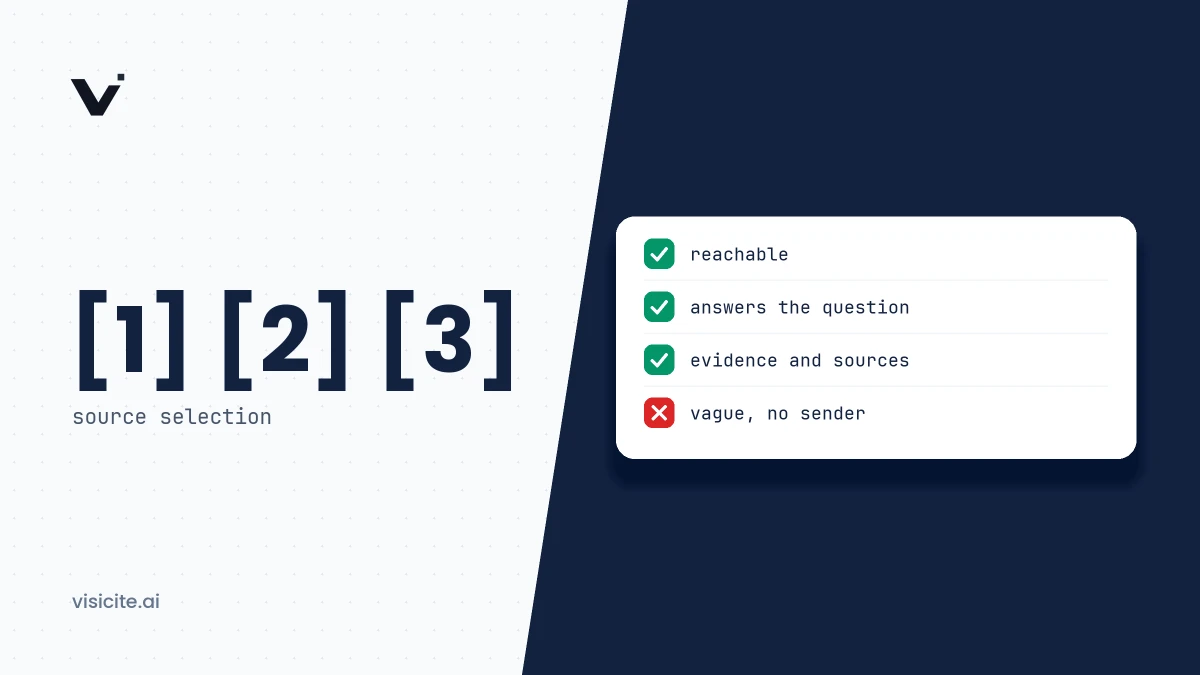
An AI service with web search selects sources in at least two steps. In the first step, a search system retrieves candidate pages and ranks them. In the second step, the language model reads a selection of those texts and writes an answer, citing some sources and not others. Authority signals such as links and the publisher's reputation may influence the first step, while the model's assessment of the text influences the second. The overall process is described in How AI search engines work: training data, retrieval and citations, and the model's perspective in How Large Language Models Choose Their Sources.
The difficulty for anyone trying to understand authority signals is that providers rarely say which step a given signal affects, or whether it affects anything at all. That makes it necessary to separate what is documented, what is a reasonable assumption and what is unknown.
What do the providers themselves say?
The table summarises what each provider has published in its own documentation, as of November 2026. Anything not listed in the middle column should be treated as undocumented.
| Provider | Documented | Not published |
|---|---|---|
| Google (AI Overviews, AI Mode) | The page must be indexed and eligible to be shown with a snippet. No additional technical requirements. The same foundational SEO best practices apply. E-E-A-T is described in the guidance on helpful content, where Google writes that E-E-A-T itself is not a specific ranking factor. | How sources are selected among ranked pages for the AI answer specifically. |
| Microsoft (Bing, Copilot) | Bing Webmaster Guidelines describe quality and trustworthiness, including the site's reputation (among other things, which sites link to it) and transparency about authorship. | How these factors are weighted when Copilot chooses which sources to cite. |
| OpenAI (ChatGPT search) | OAI-SearchBot is used so that pages can appear in ChatGPT search results. Sites that block it may be excluded. | Ranking criteria and assessment of authority. |
| Anthropic (Claude) | Separate bots for training, search indexing and user-initiated retrieval, controlled via robots.txt. | How sources are selected and ranked in Claude's web search. |
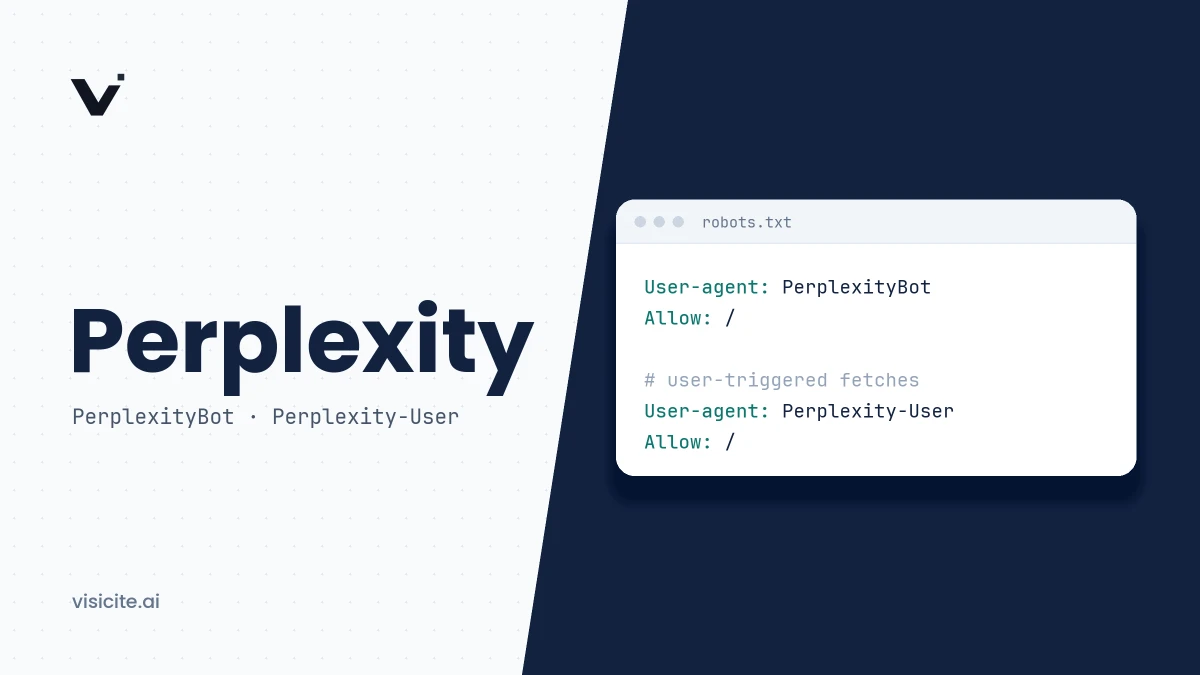
| Perplexity | PerplexityBot for showing pages in search results and Perplexity-User for user-initiated retrievals. | Ranking factors and any assessment of authority. |
The practical consequence of the table is that Google and Microsoft are the only providers with a documented connection between authority-like signals and the search system behind their AI answers. For the other providers, everything beyond technical access is assumption. Crawler details are covered in Robots.txt for AI crawlers: training, search and user-triggered bots, and Perplexity specifically in How Perplexity works.
What does Google's wording on E-E-A-T mean in practice?
Google writes that E-E-A-T itself is not a specific ranking factor, but that its systems use a mix of factors that can identify content with good E-E-A-T, and that trust is the most important part. Google also states that quality raters' ratings do not directly affect rankings. E-E-A-T is therefore a framework for what the systems try to reward, not a measurable score. No Google documentation says that the AI features make their own, separate E-E-A-T assessment. More on Google's own wording is in E-E-A-T and AI answers: what Google actually says.
What does Google say about links?
Google's guide to ranking systems in Search describes link analysis systems, including PageRank, as part of core ranking. At the same time, Google's spam policies prohibit link manipulation. Since AI Overviews and AI Mode are, according to Google, built on the same search systems, it is reasonable to assume that links influence which pages become candidates. Google has not published anything saying that links influence the choice among candidates in the AI answer.
What does published research show?
Research on AI citations is young, and most studies use test environments, custom datasets or open models rather than the commercial services as they look today. The results therefore say more about mechanisms than about exactly how ChatGPT or AI Overviews behave. A broader review is available in GEO Research 2025–2026: The Most Important Studies and What They Mean for You. Only the studies that touch on authority are covered here.
The GEO study from Princeton and others (2023, published at KDD 2024)
In the paper "GEO: Generative Engine Optimization", Aggarwal and co-authors tested different ways of rewriting content and measured visibility in generated answers. Adding citations, quotations from relevant sources and statistics had the strongest effect in their test environment, according to the authors up to 40 percent higher visibility. The study measured on-page content changes, not links or publisher reputation. It shows that signals of substantiation within the text can matter, not that external authority does.
What models find convincing (Wan, Wallace and Klein, ACL 2024)
The study "What Evidence Do Language Models Find Convincing?" examined which texts models rely on when sources contradict each other. The authors found that the models relied heavily on how relevant a text was to the query, and largely ignored stylistic features that humans consider important, such as whether the text contained scientific references or had a neutral tone. The result applies to the model step, not retrieval. It argues against the assumption that the model itself carries out a careful credibility assessment of the text it reads.
Verifiability in generative search engines (Liu, Zhang and Liang, 2023)
Liu and co-authors audited answers from several generative search engines and found that roughly half of the generated sentences (51.5 percent) were fully supported by their citations, and that 74.5 percent of citations supported the sentence they were attached to. The study applies to the systems as they were in 2023. It is a reminder that a citation does not necessarily mean the source was judged authoritative, and that the link between text and source can be loose.
Third-party sources versus owned channels (Chen and others, 2025)
The preprint "Generative Engine Optimization: How to Dominate AI Search" (2025) compared the sources in AI search services with Google's search results and reported that the AI services cited third-party sources, so-called earned media, more often than brands' own websites. The study is not peer reviewed and reflects a particular point in time and a particular set of queries. It is nonetheless one of few attempts to measure mentions by others as a factor.
Documented, plausible or unknown: signal by signal
The table brings together the status of the four signals in question. The category "reasonable assumption" means the conclusion follows logically from documentation or research but has not been confirmed for AI answers specifically.
| Signal | Documented | Reasonable assumption | Unknown |
|---|---|---|---|
| Links | Part of Google's and Bing's ranking in regular search. | Influence which pages become candidates in AI services built on these indexes. | Whether links influence the choice of cited source among candidates. |
| Unlinked mentions | No provider documents them as a signal. | More mentions increase the chance that a third-party page about you is retrieved, and that the model knows the brand from training data. | Whether mentions are used as a direct ranking factor. |
| Publisher and author | Bing mentions transparent authorship. Google describes the question "who created the content" in its guidance on helpful content. | A clear publisher contributes to trustworthiness assessments in the search step. | Whether author markup in schema affects AI citations. |
| E-E-A-T | A framework in Google's guidance, according to Google not a single ranking factor. | What the systems reward in Search carries over to AI features built on Search. | Whether other providers have an equivalent assessment. |
Which conclusions should you not draw?
Several common claims go further than the evidence supports. They are worth recognising because they lead to misplaced priorities.
- "AI services have an E-E-A-T score." Neither Google nor any other provider describes such a score. Adding author names to raise an imagined score has no documented support.
- "Author schema creates authority." Structured data helps machines read who is behind a text. Google has explicitly said that the AI features do not require any special markup. Schema is a way to make existing information clear, not a source of authority in its own right.
- "Bought links lead to more AI citations." Link manipulation violates Google's spam policies, and there is no published evidence that it would work in AI answers.
- "Correlation is causation." Analyses showing that cited sites have many links can be explained by the same sites also having more content, older domains and more mentions. Without controlled experiments, the effect of links cannot be isolated.
What can you do regardless of what turns out to be true?
Some actions are valuable under all three scenarios: authority signals weigh heavily, they only affect the search step, or they barely matter. The order below runs from what is best documented to what rests more on reasonable assumptions. The longer-term strategy for building credibility is described in Digital Authority for GEO and is not repeated here.
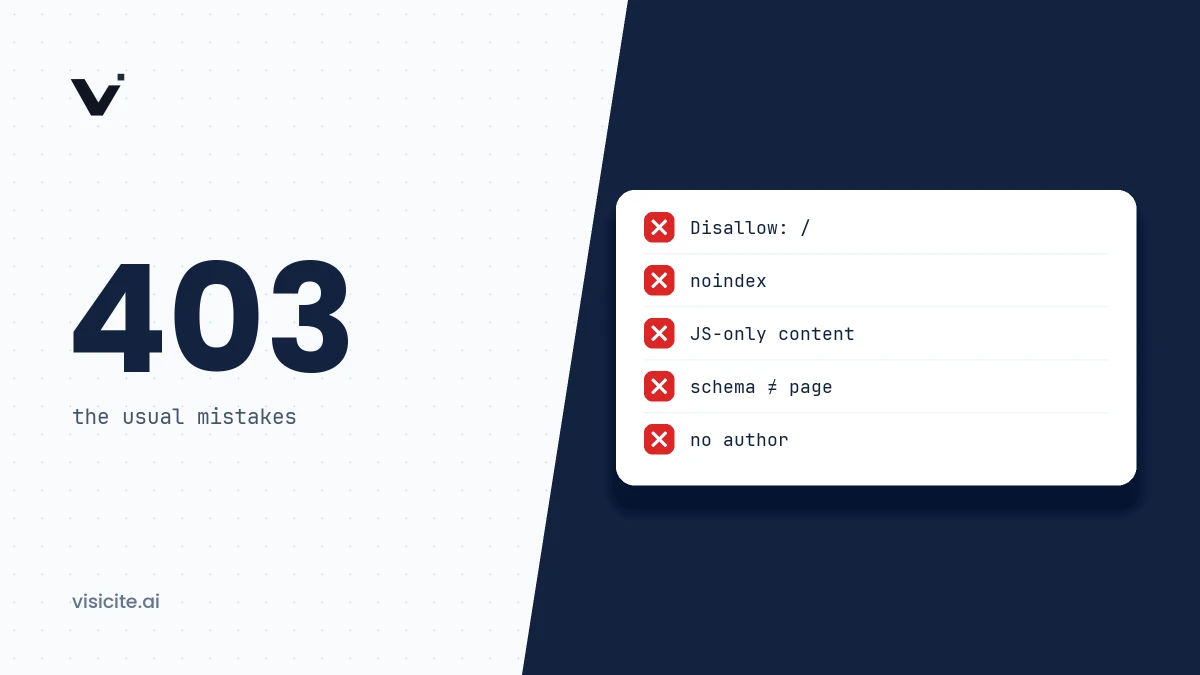
- Ensure access and indexing. This is the only thing every provider documents. Check that search bots are not blocked in robots.txt, that pages are indexed in Google and Bing, and that snippets are not accidentally restricted with nosnippet or max-snippet.
- Write for relevance first. The research from Wan and co-authors suggests that relevance to the query weighs most in the model step. Give every page a clear main answer that a model can reproduce without interpretation.
- Substantiate claims in the text. Named sources, quotations and figures with a stated origin had an effect in the GEO study's test environment and are also good editorial practice.
- Make the publisher clear and consistent. Show organisation, author and contact details visibly, and describe them the same way on the site, in structured data and in external profiles. This matches both Google's and Bing's wording about who is behind the content.
- Get mentioned by others for real reasons. Original data, tools, clear positions and expertise that journalists and industry sites want to reference produce both links and mentions. That helps you in the search step and means third-party pages about you can be retrieved.
- Measure instead of assuming. Track a fixed set of queries over time and note which sources are cited, including competitors and third parties. Methods are described in How to Measure GEO Results.
Example: a publisher description before and after
The difference between an unclear and a clear publisher is often a matter of a few sentences. The example shows an article byline.
Before: "Written by the editorial team."
After: "Written by Jane Example, electrical safety manager at Example Electric Ltd since 2015. Reviewed by John Example, licensed electrician. Last updated 10 November 2026."
The second version does not guarantee a citation or a better ranking. It does make the publisher, experience and freshness readable for both people and machines, which is what Google and Bing describe in their guidelines.
How do you check the prerequisites on your own site?
Access and publisher clarity can be reviewed systematically, while external authority has to be tracked with other methods. Among other things, Visicite runs E-E-A-T checks for an identifiable sender, named authors, external sources and entity consistency, together with technical checks of AI crawler rules and snippet limits. The score measures technical and editorial prerequisites and does not predict whether the site will be cited. A rule-based free GEO scan of one URL requires no account.
Frequently asked questions
Are links important for getting cited by AI?
Links are documented as a ranking factor in Google's and Bing's regular search, and the AI features from Google and Microsoft are built on those search systems. It is therefore reasonable that links influence which pages become candidates. Whether links influence the actual choice of cited source has not been published.
Does E-E-A-T affect AI Overviews?
Google describes E-E-A-T as a framework, not a single ranking factor, and states that AI Overviews are built on the same systems as Search. What the systems reward in Search therefore likely carries over, but no separate E-E-A-T assessment for AI answers is documented.
Do unlinked mentions count?
No provider documents unlinked mentions as a ranking signal. Mentions can still have an indirect effect, because pages that mention you can be retrieved and cited, and because brands that appear often are present in models' training data.
Does the language model itself judge whether a source is credible?
The research from Wan, Wallace and Klein (ACL 2024) suggests that models rely mainly on relevance and largely ignore features such as scientific references and neutral tone. The credibility assessment therefore likely happens mainly in the search step, but this is not documented for the commercial services.
Does author schema help with AI citations?
There is no published evidence that author schema in itself increases AI citations, and Google requires no special markup for its AI features. Author schema is useful for making visible publisher information machine-readable and consistent.